Back
Back
 5 min?>
Integrated Planning is a modern management approach that brings together a company's strategic and operational objectives within a single, unified process. It helps to turn business goals into actionable plans for production, logistics, procurement, and finance, ensuring alignment across functions and reducing operational risks. In the metals and mining industry, Integrated Planning enables organisations to synchronize complex production and processing value chains, optimize the utilisation of resources, and improve overall management effectiveness.
Benefits of Integrated Planning in the Metals and Mining Industry
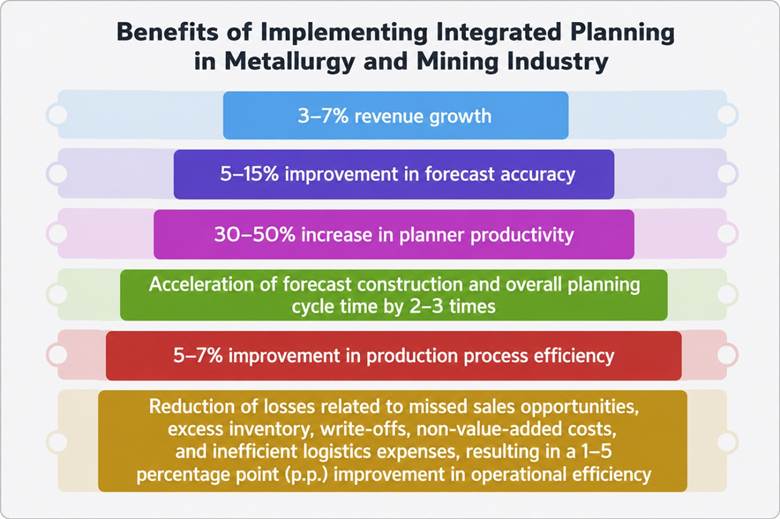
Drawing on Knowledge Space’s extensive experience working with metals and mining companies, we help organisations achieve significant business outcomes, including:
- 3–7% revenue growth
- 5–15% improvement in forecast accuracy
- 30–50% increase in planner productivity
- Acceleration of forecast construction and overall planning cycle time by 2-3 times
- 5–7% improvement in production process efficiency
- Reduction of losses related to missed sales opportunities, excess inventory, write-offs, non-value-added costs, and inefficient logistics expenses, resulting in a 1–5 percentage point (p.p.) improvement in operational efficiency
The Knowledge Space team has extensive experience in the digitalisation and automation of business processes within metals and mining enterprises, including planning and management processes.
When it comes to planning, we believe it is critically important to account for the specific characteristics of a company's production, technological, and related business processes at the highest level of detail.
What Are the Key Considerations When Digitalizing Planning Systems for Metals and Mining Companies?
Pull-Based and Push-Based Planning Approaches
A pull-based planning approach is a method in which the output of the supply chain is defined first—for example, a target sales volume. The system then sequentially simulates all processes required to fulfill the sales plan, including production, logistics, procurement, and other activities, while taking into account all existing constraints. In FMCG companies, with which we also work extensively, this approach is commonly used.
In other industries, however—for example, in certain oil and gas processes—a push-based planning approach is typically applied. A push-based planning method starts with the input parameters of the supply chain, such as the volume of oil production. The model then simulates the entire supply chain, considering all constraints, and determines the resulting output in terms of finished products and sales.
In this regard, a metallurgical company combines both pull-based (for example, the sale of rolled steel products) and push-based (for example, mining and beneficiation operations) planning models. An integrated planning system for a metallurgical company must therefore be highly flexible in supporting both planning approaches and capable of effectively balancing them through the use of various optimisation techniques.
Specific Characteristics of Metals and Mining Operations
In addition, the metals and mining industry has a number of unique characteristics that distinguish metals and mining companies from organisations in other sectors. These distinctive features, in turn, impose specific requirements on planning digitalisation systems. These requirements are presented in the table below.
| Feature | Corresponding requirements for the planning system | |
|---|---|---|
| Analysis of large volumes of data characterizing technological processes in metallurgy and mining companies requires the use of advanced visualisation tools |
In addition to standard forms of data presentation (tables and charts), interactive mnemonic diagrams are highly in demand. Interactive mnemonic diagrams enable clear visualisation of production processes (technological operations with involved resources), highlight bottlenecks, and display quantitative indicators dynamically. |
|
| Production planning in metallurgy is complicated by the presence of feedback (recirculation) processes, the simulation of which requires advanced functionality for handling infinite cycles |
The planning system for a metallurgical and mining company must support the calculation of complex cyclic dependencies. For example, an in-memory computing engine and the no-code Knowledge Space model builder allow configuring and applying arbitrary iterative calculations of cyclic dependencies, enabling full and highly accurate planning of even the most complex metallurgical processes. |
|
| Limited applicability of optimizers is related to the fact that, for correct problem formulation, mathematicians need to involve a wide range of technological and production experts whose knowledge must be formalized in a transparent format that ensures two-way communication between experts and mathematicians both at the stage of problem formulation and at the stage of system configuration and operation |
To solve complex optimisation problems, the system requires the implementation of a digital twin of production. The production digital twin describes production processes in a visual format understandable to all categories of experts. The digital twin acts as a problem setter for the mathematician and then clearly demonstrates to experts the quality of optimizer performance, ensuring effective communication and guaranteeing the quality of optimisation solutions. |
Without the technological capabilities described above, the system cannot fully meet the needs of digitalisation of planning systems in metallurgical and mining enterprises.
All the above requirements are fully implemented on the Knowledge Space platform Knowledge Space.
Examples of Automation Projects for Planning Systems in Metallurgical and Mining Companies
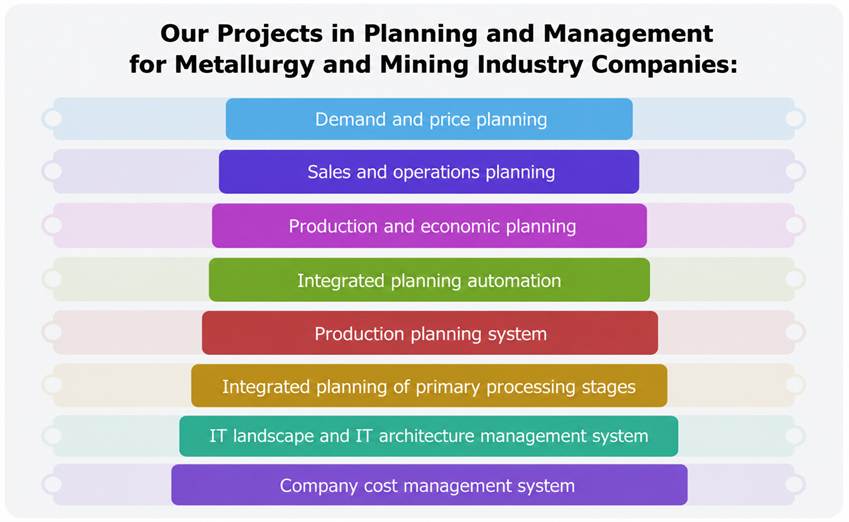
The Knowledge Space team’s experience includes the following digital planning and management projects for five different companies in the metallurgical and mining industry:
- Demand and price planning
- Sales and operations planning
- Production and economic planning
- Integrated planning automation
- Production planning system
- Integrated planning of primary processing stages
- IT landscape and IT architecture management system
- Company cost management system
More detailed information about projects based on Knowledge Space is available here.
What are the effects of implementing integrated planning in the mining and metallurgical industries
All key effects of implementing individual system modules are presented in the detailed description of Knowledge Space-based Products.
More details in our presentation on integrated planning in metallurgy.
An example of integrated planning for a metallurgical holding is available in video format – we invite you to watch the Demo.
We also invite you to read the interview with the Project Manager of the “Automation of the production and economic planning system of MMC Norilsk Nickel”: Link to the interview on integrated business planning in metallurgy of MMC Norilsk Nickel
Learn how Knowledge Space can implement integrated planning at your enterprise.
Author: Zoya Taranchenko, Business Development Director at Knowledge Space and an expert in Integrated Business Planning.