Back
Back
 5 min?>
What is Integrated Business Planning and what business benefits can it provide?
Table of Contents
- Integrated Business Planning (IBP)
- History of IBP Systems
- What is being integrated?
- IBP Components
- IBP Effects
- How to Automate IBP?
Integrated Business Planning (IBP) ↑ Back
Integrated Business Planning is one of the most modern approaches to planning the activities of commercial companies. Today, integrated planning platforms are actively developing together with the evolution of information technologies. That is why there is no single universally accepted definition of IBP.
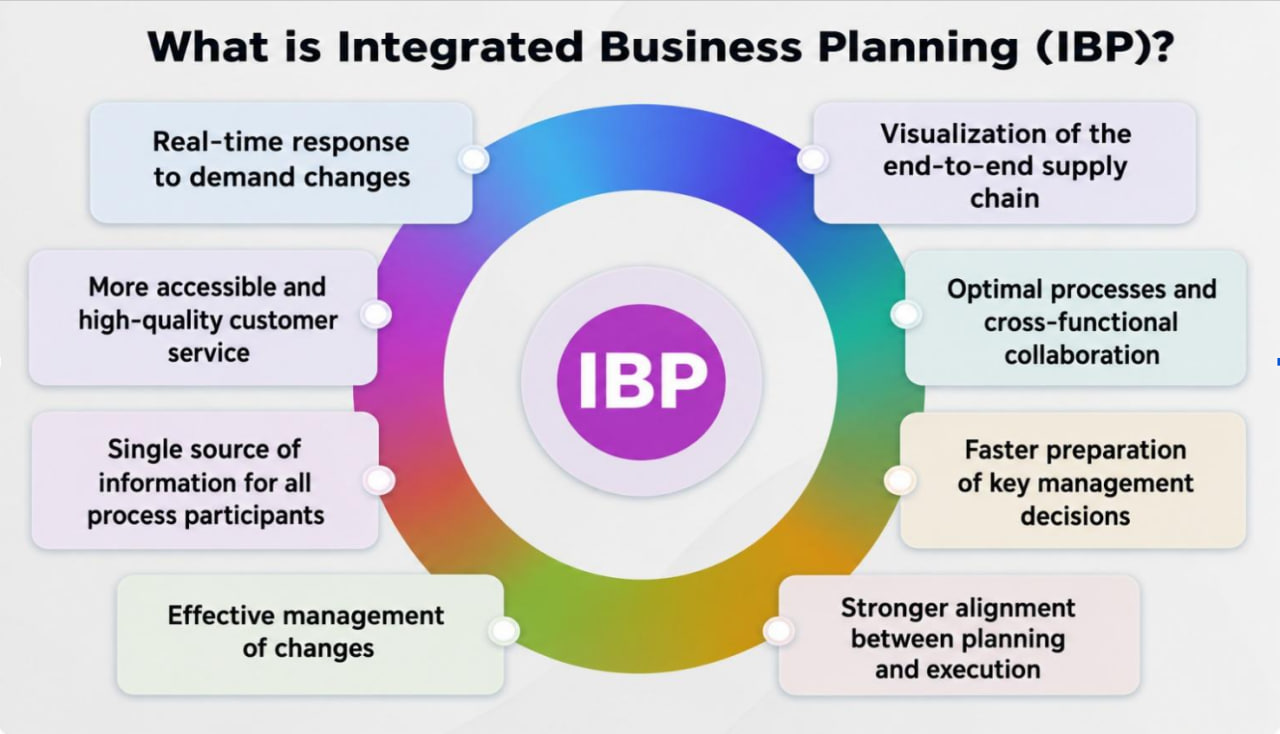
Integrated Business Planning (IBP) is:
- A practical tool for transforming a company’s strategic goals into an operational activity plan.
- A process that combines strategic and operational objectives of a company. It connects all departments and key ecosystems — production, logistics, finance, marketing, and sales — into a single process.
- A process of converting desired business results into operational and financial resource requirements in order to maximize target indicators (profit and/or cash flow) while reducing risks and automating processes.
- A strategic process that aligns an organisation’s business goals with operational and financial plans to ensure coordinated decision-making and optimize production and reporting. It expands on traditional sales and operations planning, expanding its capabilities and integrating everything needed to accomplish these tasks through the IBP platform.
History of IBP Systems ↑ Back
The IBP approach is currently one of the most advanced methods in corporate planning. It includes all achievements of Sales and Operations Planning (S&OP) and expands them with corporate performance management tools.
Sales and Operations Planning (S&OP)
S&OP is a structured planning process where forecasted customer demand is used to create production schedules. It is a cross-functional activity involving sales, production, supplier management, and other departments. S&OP can be considered the direct predecessor of IBP.
The development of the main principles of S&OP began alongside the emergence of the concept of Aggregate Production Planning (APP) in the first half of the 1950s. They were then further developed within the concept of Manufacturing Resource Planning (MRP II) around 1985 and eventually evolved into the modern, though relatively established, S&OP approach designed to balance demand and supply within a company.
The term S&OP itself and its modern meaning emerged in the 1980s and are generally attributed to Richard Ling, a management consultant at the consulting company Oliver Wight.
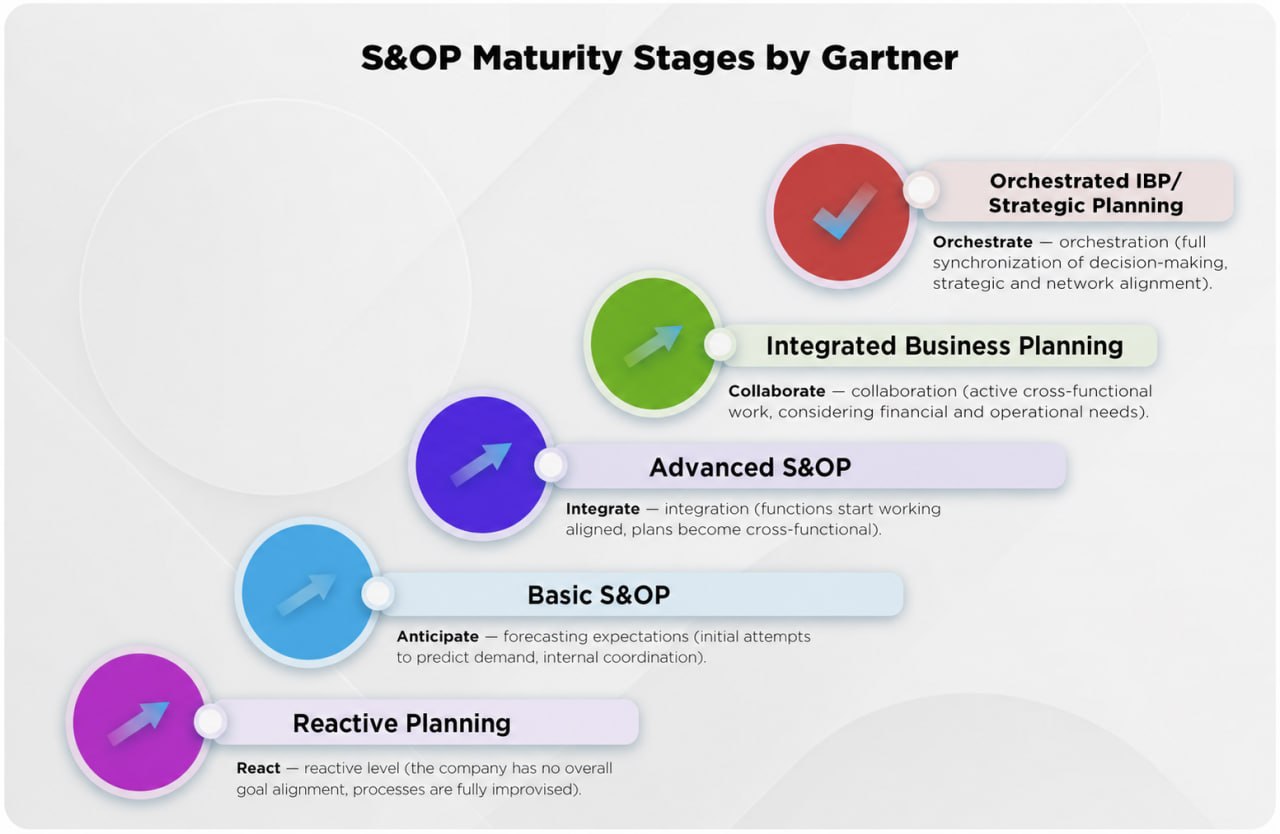
Gartner developed a five-stage S&OP maturity model, where IBP essentially represents the upper levels — the fourth and fifth stages.
What is being integrated? ↑ Back
Planning specialists from different industries, with diverse experience and responsibilities, generally agree that the fundamental difference between IBP and earlier planning approaches lies precisely in the word “integrated.” To understand what this concept includes, it is necessary to answer the question: what exactly was previously disintegrated?
| Company Functions | Sales, production, procurement, personnel, and others. |
| Time Horizons | Strategic, medium-term, operational, short-term, and others. |
| Performance Indicators | Volume-based, specific, driver-based, quantitative, financial, and others. |
| Plan Types | Volume, calendar, financial, and others. |
| Methodologies | Forecasting, scenario analysis, factor analysis, monitoring, and others. |
| Tools | Simulation modeling, optimisation tools, statistical methods, artificial intelligence, visualisation, and others. |
| IT Solutions | ERP, MES, CRM, SCM, BI, BPMS, various accounting systems, and others. |
This list is open-ended and invites everyone interested in the topic of planning, as well as integrated business planning platforms, to consider what else could be added to it.
IBP Components ↑ Back
The IBP approach is the most relevant and advanced approach in corporate planning and is reflected in modern software products. It has already incorporated all the developments of Sales and Operations Planning (S&OP) and expanded them with corporate performance management tools.
Demand & Promo Planning (DP)
Read moreForecasting demand indicators based on the facts of previous periods using various mathematical methods and expertise.
Supply Network Planning (SP)
Read moreBalancing plans for all links in the supply chain.
Detailed Production Scheduling (DS)
Read moreDetailed calendar-based production planning.
Economical & Financial Management (FM)
Read moreBusiness planning and budgeting.
Strategic Planning & Value Management (VM)
Read morePlanning key performance indicators over the long term.
Investment & Project Management (IM)
Read moreManagement of investment projects and portfolios.
IBP Effects ↑ Back
In 2022, McKinsey consultants described IBP as "a better way to drive your business" in the context of digital transformation. Let us examine what this means from the perspective of process and economic efficiency.
Summarizing the assessments provided by Forrester analysts, SAP researchers, Deloitte business consultants, and based on more than 20 years of experience of business analysts and KS experts in the market, we present the key effects of the digital implementation of automated IBP processes.
The overall economic impact of an IBP system can be defined as an increase in overall economic efficiency (profitability) by 2 to 10 percentage points (p.p.).
This effect is achieved at all stages of the value chain and includes the following key components.
In terms of planning processes and their effectiveness:
- Increasing planning and analysis speed by 50% or more.
- Reducing effort spent on plan synchronisation and collaboration by up to 90%.
- Reducing IT involvement when creating and changing planning models by 90% or more.
In terms of revenue and customer experience:
- Increasing sales and company revenue by 2–10% within a year.
- Improving order fulfillment indicators by 10–15% and enhancing customer experience.
In terms of supply chain, inventory, and logistics:
- Increasing production efficiency by 10–15%.
- Increasing product availability in warehouses by 5–10% on average.
- Reducing inventory levels by 5–15%.
- Reducing losses from obsolete inventory by 10–20%.
In terms of cost optimisation, the use of integrated planning platforms leads to a reduction in total costs by 1.5–20%, depending on the industry and the initial quality of planning and operational execution processes, including through:
- Reducing non-productive costs by 50–90%
- Reducing total logistics costs by 10–15% through improved planning and operational control.
How to Automate IBP? ↑ Back
The technological process of Integrated Business Planning requires integration of plans across different company functions and time horizons. Due to its complexity and the large amount of data and specialists involved, it is practically impossible to implement IBP effectively without modern technologies.
IBP platforms and services use predictive analytics, optimisation tools, integration solutions, and many other technologies. The description of IBP systems and the process of their implementation deserve special attention; this topic will be covered in a separate article.
Author:
Zoya Taranchenko, Business Development Director at Knowledge Space, expert in integrated planning.