Back
Back
 7 min?>
Table of Contents
- Challenges Facing the Modern Oil & Gas Industry
- Why Integrated Planning Is Becoming a Necessity
- Oil Production: Practice and Economics
- What Is the Oil & Gas Value Chain?
- How the KS Platform Transforms the Value Chain
- Conclusions
Challenges Facing the Modern Oil & Gas Industry ↑ Back
The oil & gas industry is a true giant of the global economy, without which modern life would be impossible. But even giants face significant challenges. Today, the industry is confronted with a number of serious issues:
- Unpredictable prices: Oil and gas prices can fluctuate dramatically, creating uncertainty for businesses and making long-term planning more difficult.
- Environmental requirements: Expectations regarding corporate environmental responsibility continue to increase, forcing oil & gas companies to adapt to new regulations and seek greener solutions.
- The need to operate more efficiently: To remain competitive and maintain profitability, companies must continuously look for ways to improve processes and reduce costs.
In this environment, a conventional approach is no longer sufficient. Integrated planning in the oil & gas industry is a process in which the entire value chain—from oil and gas production to product delivery to the end customer—is viewed as a single, interconnected system. This approach has become a critical prerequisite for effective management.
Why Integrated Planning Is Becoming a Necessity ↑ Back
Why is this so important?
- Maintaining competitiveness: Companies that effectively manage their entire value chain can respond more quickly to market changes, offer more competitive terms to customers, and bring new products to market faster.
- Sustainable development: An integrated approach enables companies not only to generate profits today but also to think about the future—minimizing environmental impact, ensuring supply stability, and maintaining long-term business resilience.
Simply put, modern oil & gas companies need to view their business as a single, integrated system. This approach improves operational efficiency, reduces costs, helps address industry challenges, and enables companies to move forward with confidence.
Oil Production: Practice and Economics ↑ Back
The oil production process is a complex, multi-stage cycle that can be viewed from both practical and economic perspectives.
From a practical standpoint, it includes:
- Geological exploration: Identifying and evaluating hydrocarbon reserves using seismic surveys, exploratory drilling, and geological data analysis.
- Constructing production wells and installing the equipment required for extraction (pumps, tubing, and wellhead equipment).
- Production: Extracting oil and gas from the reservoir using various production methods (natural flow, artificial lift, and gas lift).
- Primary processing: Separating oil from water, gas, and mechanical impurities directly at the production site.
- Transportation: Moving the extracted hydrocarbons via pipelines, tankers, or rail to processing facilities or storage terminals.
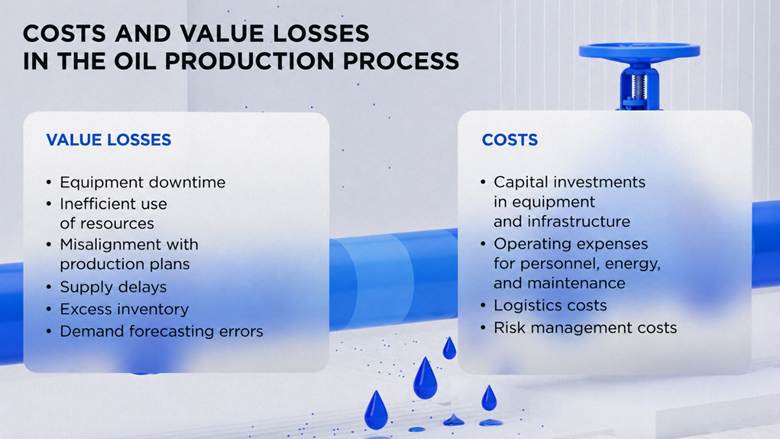
From an economic perspective, each of these stages involves significant costs: capital investments in equipment and infrastructure, operating expenses for personnel, energy, and maintenance, as well as logistics and risk management costs. The efficiency of every stage directly affects the final production cost of the extracted oil and, consequently, the overall profitability of the enterprise.
What Is the Oil & Gas Value Chain? ↑ Back
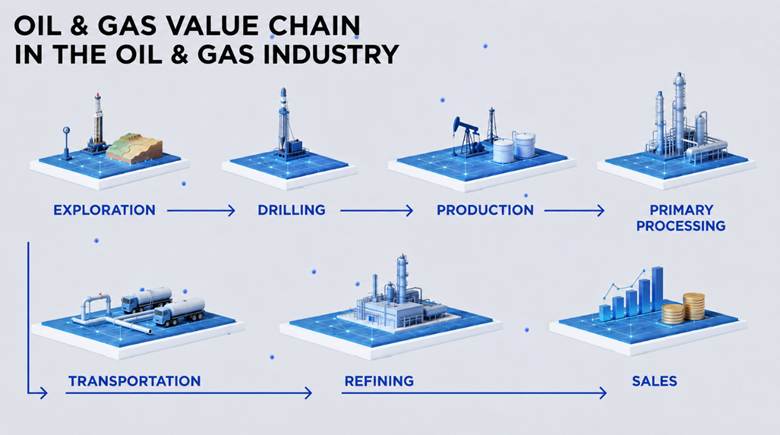
The oil & gas value chain encompasses the entire lifecycle of a product—from exploration of an oil or gas field to the delivery of finished products to the end customer. In addition to the stages described above (geological exploration, drilling, production, primary processing, and transportation), it also includes refining and sales.
At every stage of the value chain, value losses may occur due to equipment downtime, inefficient use of resources, misalignment of production plans, supply delays, excess inventory, and demand forecasting errors. As a result, effective value chain management has become one of the key drivers of business performance. This is where integrated operations in the oil & gas industry play a critical role by bringing together data and processes into a single management system.
How the KS Platform Transforms the Value Chain ↑ Back
The implementation of modern digital platforms such as the KS Platform creates new opportunities to improve the efficiency of the entire oil & gas value chain. The objective is not only to automate individual processes but also to build a unified, integrated ecosystem where every stage is synchronized and optimized to maximize overall performance.
This approach aligns with the goals of oil & gas digitalisation and supports the industry's digital transformation strategy.
Key Optimisation Areas Enabled by the KS Platform:
1. Cost Reduction
- Predictive maintenance and failure prevention. By leveraging sensor data and predictive analytics, the KS Platform identifies potential equipment issues before they occur. This reduces emergency repair costs, minimizes downtime, and prevents production losses.
- Improved resource utilisation. Analysis of energy, water, and other resource consumption across every stage of operations helps identify inefficiencies and implement targeted improvements.
- Inventory optimisation. Accurate forecasting of material and spare parts requirements, combined with optimized inventory levels, reduces storage costs while preventing material shortages.
2. Eliminating Unnecessary Processes and Bureaucracy
- Digital document management. Converting workflows—from permitting documentation to regulatory reporting—into digital processes shortens approval cycles, minimizes errors, and reduces administrative costs.
- Automation of routine operations. The platform automates data collection, reporting, planning, and monitoring, allowing employees to focus on higher-value strategic activities.
- Unified information environment. All participants across the value chain have access to real-time, up-to-date information, eliminating duplicate data and reducing the risk of miscommunication.
3. Synchronizing Production, Transportation, and Processing
- Dynamic production planning. The KS Platform enables production plans to be adjusted in real time based on current refinery demand, transportation capacity, and market conditions. This helps prevent both overproduction and feedstock shortages.
- Improved logistics efficiency. By integrating data from oil fields, processing facilities, and transportation networks, the platform identifies the most efficient logistics routes, minimizing delivery times, transportation costs, and operational risks.
- Coordination of production cycles. The platform provides end-to-end visibility and synchronisation across production, transportation, and refining operations.
- Supply and demand management. The KS Platform can integrate with sales management and demand forecasting systems, enabling synchronized planning across the entire value chain.

Conclusions ↑ Back
Integrated planning in the oil & gas industry is no longer just a modern management approach—it has become a critical tool for improving business performance. Integrating production, transportation, processing, and sales into a single system enables companies to reduce costs, increase operational transparency, and respond more quickly to changing market conditions.
The KS Platform supports value chain management principles, enables integrated operations across the oil & gas industry, accelerates digital transformation, and provides the tools needed to optimize the oil & gas supply chain.
Article: Read
Video: Watch
Presentation: Explore