Back
Back
 10 min?>
Table of contents:
- What is budgeting in simple terms and what is it for?
- Company budgeting goals
- Main budgeting methodologies
- Budgeting principles
- Where to start the budgeting process in a company
- Types of budgets in an organisation’s budgeting system
- Stages of budgeting in a company
- Difficulties in the budgeting process
- Example of the budget formation process
- Modern financial planning trend: Transition to xP&A
- Conclusions and key points
In conditions of high economic uncertainty, budgeting and financial planning are becoming increasingly important as a tool for assessing options for future development and for rapid response to changes.
In this article, we will discuss what the budgeting process of companies represents in the modern world, and in which direction the development of budgeting is heading.
Want to learn more?
Discover the capabilities of the “Economics and Finance Management” product for budgeting and financial planning automation.
What is budgeting in simple terms and what is it for? ↑ Back to contents
There are many definitions available online; we offer the following one—focused on commercial companies.
Budgeting is a cross-functional management business process of a company aimed at forming a system of budgets as a tool for managing the achievement of the company’s financial and economic goals.
In large companies and holding groups, budgeting is an integral part of the corporate financial planning system, ensuring alignment of strategic and operational goals.
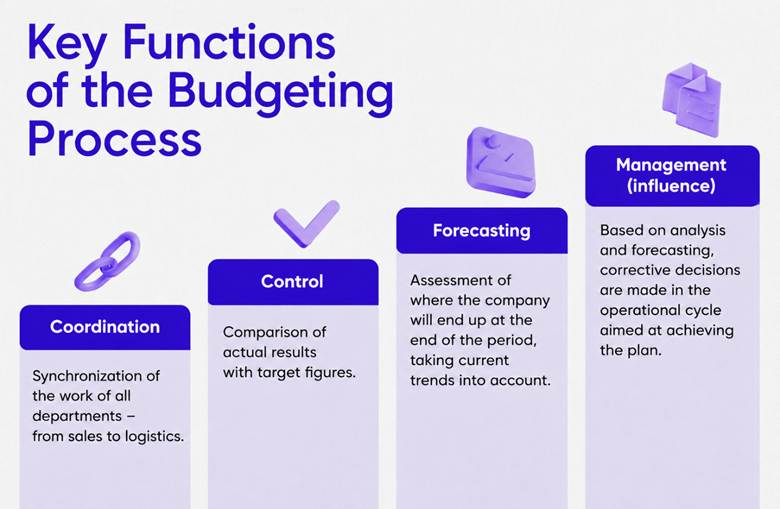
Key functions of the budgeting process in an enterprise:
-
Coordination: Synchronisation of the work of all departments – from sales to logistics.
-
Control: Comparison of actual results with target figures.
-
Forecasting: Assessment of where the company will end up at the end of the period, taking current trends into account.
-
Management (influence): Based on analysis and forecasting, corrective decisions are made in the operational cycle aimed at achieving the plan.
A budget always implies both sides of the economic chain: on the one hand – the volume of income expected from the business is defined; on the other hand – the expense limits of financially responsible departments.
Planning of investment projects is closely linked to the main budgeting process of the company. Flexible financial planning and management of project funding allows continuous improvement of operational efficiency.
There are many types of budgets and different levels of their detail and, conversely, consolidation; however, probably any economist would say that everything is based on the “three pillars” – financial reporting forms:
| Financial reporting form / budget | What it reflects | What it is used for |
| PL / P&L / Income Statement / Budget of income and expenses | Company revenues, expenses and financial result for a period | Used to assess business profitability, control profitability, analyze cost structure and plan financial results |
| CF / Cash Flow / Cash Flow Budget | All cash inflows and outflows of the company | Allows managing liquidity, forecasting cash gaps and controlling the sufficiency of cash resources |
| BS / Balance Sheet / Balance | Company assets, liabilities and equity | Used to assess the financial stability of the business, asset structure and sources of financing |
Company budgeting goals ↑ Back to contents
Each company defines its own priority goals for financial and economic planning and builds its own budgeting system. However, there is a set of standard—classic and universally applicable—budgeting goals.
-
Financial resource planning. The company’s financial director must know whether there is sufficient cash available to cover the company’s financial needs at every future point in time. Without this, the business will inevitably face cash gaps, risks, and losses.
-
Control of income and expense plan execution. Through tools of plan–actual analysis, variance factor analysis, and comprehensive analysis of planning and budgeting processes, the finance function obtains an effective tool for controlling the activities of all company departments.
-
Motivation of performers through financial KPIs. Effective monitoring and control of deviations from the plan make it possible to establish a system of transparent and effective motivation for all managers and employees of the company to achieve set financial goals.
-
Efficient management of operational resources. Based on budgeting and analysis, it is possible to assess and manage the efficiency of resource usage. For performance management purposes, driver-based planning is especially effective; this will be discussed later in the article.
-
Efficient investment management. The budget of investment projects is not just a spending limit, but the result of a balanced analysis and conscious decisions about which projects should be invested in to achieve the best business outcome and how to manage these project budgets. In this context, financial planning of investment activity makes it possible to assess the feasibility of investments and manage their efficiency at all stages of project implementation.
-
Proactive risk management. Within budgeting, the focus is mainly on financial risk management, but a flexible budgeting model also helps assess the financial consequences of risks arising within the company’s core business processes.
-
Support for managerial decision-making. In most cases, financial indicators are key factors in making managerial decisions. From this perspective, rapid “what-if” analysis helps management feel more confident, relying on numbers rather than intuition.
Main budgeting methodologies ↑ Back to contents
Modern companies choose an approach depending on the maturity of their business processes, increasingly implementing integrated financial management information systems that allow automation of calculations and faster decision-making:
1. Traditional budgeting (Incremental Budgeting)
The new budget is built based on last year’s data with the addition of a certain percentage (“based on achieved results”).
The advantages of this approach are simplicity and speed. The disadvantages are low efficiency, since past mistakes are carried forward into the future.
2. Zero-Based Budgeting (ZBB)
Each period, managers must justify every expense item from scratch, as if the business is starting from a clean slate.
The main advantage of this approach is deep cost optimisation. The disadvantage is extremely high labor intensity. Therefore, to optimize costs, companies often identify the most significant cost items (using the ABC method) and apply the ZBB approach selectively to them.
3. Driver-Based Planning
Budget figures are automatically calculated based on operational “drivers” (sales volume, number of employees, productivity norms). This is the most accurate method for large companies. It can also be labor-intensive in the initial stages, but after developing the methodology and establishing a base of standards, it becomes a key tool for managing economic efficiency. The effect is impressive (tested in many companies).
In practice, companies often combine different budgeting techniques, adapting them to the specifics of the business and current tasks.
Budgeting principles ↑ Back to contents
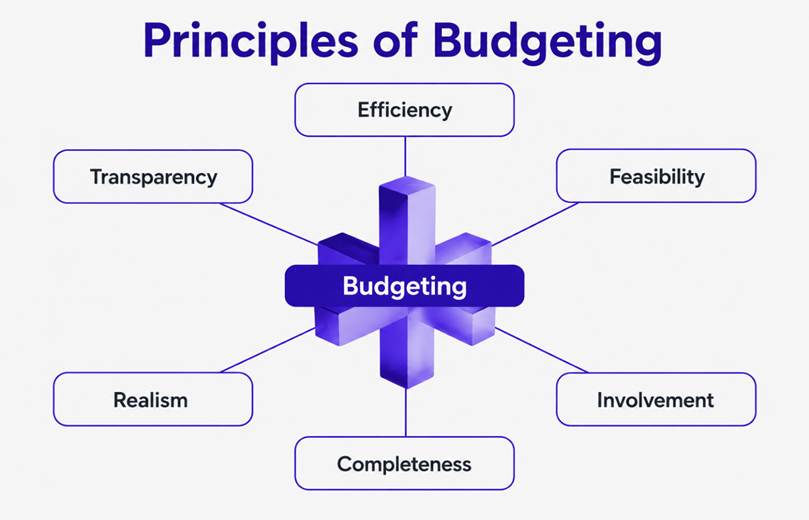
To ensure that the implementation of a budgeting system is effective, the following principles should be followed:
-
Completeness. The MECE principle (Mutually Exclusive, Collectively Exhaustive). This principle relates to the structure of budget items: they must cover all revenues and expenses (inflows and outflows), while there should be no duplication.
-
Realism. Plans must be based on actual processes and their quantitative indicators. If the set targets are not achievable (for example, unrealistically inflated revenue expectations or clearly insufficient resources planned to complete assigned tasks), such a budget is meaningless and will not provide any managerial effect other than demotivating employees.
-
Transparency. Each income and expense item must be calculated in a defined and understandable way, and it must be possible to verify how each figure included in the budget was obtained. The presence of “grey areas” is unacceptable.
-
Efficiency. The methodology and tools of enterprise budgeting management must be configured in such a way as to help the company use resources most effectively, achieving maximum possible results with optimal costs. If the budgeting tool does not have this capability, it provides very little value.
-
Feasibility. Budgeting processes, methods, and tools must correspond to the company’s goals and capabilities. In other words, the use of budgeting tools should deliver significantly greater effect than the labor and financial costs of creating them. This is especially important when developing financial planning at an enterprise level, when the entire financial management system is being formed.
-
Involvement. All departments that in one way or another affect the company’s revenues and/or expenses must be involved in the budgeting process. To structure roles in the budgeting process, a financial structure of the enterprise is usually developed—similar to an organisational structure, but operating with the concept of a “financial responsibility center” (FRC) instead of a “structural unit.” At the same time, FRCs and organisational units must correspond to each other in a defined way.
Where to start the budgeting process in a company ↑ Back to contents
Implementing budgeting should not start with selecting software or trying to immediately build a complex financial model. At the initial stage, it is much more important to define the objectives of the process and establish basic planning rules.
Typically, companies go through several sequential steps:
1. Defining budgeting objectives
It is necessary to understand what tasks the system should solve: cost control, liquidity management, profitability improvement, evaluation of investment projects, or support for managerial decision-making.
2. Forming the financial structure
At this stage, financial responsibility centers (FRCs), budget owners, and the areas of responsibility of departments are defined.
3. Developing the budget structure
The company determines the composition of budgets, income and expense items, the level of detail, and rules for data consolidation.
4. Defining process regulations
It is important to predefine planning timelines, approval procedures, budget revision rules, and the list of process participants.
5. Selecting automation tools
At early stages, companies often use Excel; however, as the business grows, there is a need for specialized budgeting and financial planning systems.
Practice shows that even a relatively simple and transparent budgeting model usually brings more value than a complex system that departments do not use in real operations.
Types of Budgets in an Organisation’s Budgeting System ↑ Back to contents
From the perspective of objectives and areas of application, budgets can be divided into three main types:
Operating Budget. This is the Profit & Loss (P&L) budget related to the company’s core, supporting, and management business processes. Usually it includes budgets from various functional departments (FRCs). For example, the revenue budget may be prepared by the commercial department. Expense budgets are prepared by each department that incurs costs—for production, energy supply, equipment maintenance, and so on. These budgets are developed at the lowest level (branches, departments, products) and consolidated at the company level. Management expenses, on the contrary, are formed centrally (at the top level) and then allocated to final products according to a methodology defined by the company. The operating budget always serves as the foundation for both the investment budget and the financial budget.
Investment Budget. This is the capital expenditure (CAPEX) budget, covering investments that are not directly included in the cost of finished products but are gradually transferred through depreciation. Investments can take many forms—equipment, real estate, development of intangible assets (IA), acquisition and implementation of major software systems, and more. Investment projects should always generate future benefits for the company. For example, today a company invests in developing a new product and building a new production line; six months later, the new product becomes a core sales driver, gradually reaches the break-even point, and subsequently generates profit for the company.
Financial Budget. This is the Cash Flow (CF) budget. The financial budget includes all cash inflows and outflows related to operating activities (revenue from product sales, procurement of materials and resources for production, salary payments, contractor services, etc.), as well as investment expenditures (for example, purchasing new equipment) and financial income and expenses (for example, interest on a loan taken to purchase that equipment). The primary objective of this budget is to manage the company’s liquidity and prevent cash flow gaps. It is also important to make use of opportunities to place temporary surplus funds in deposit accounts.
It is particularly important to take industry-specific characteristics into account, for example when budgeting for a manufacturing company, where production and logistics costs play a significant role.
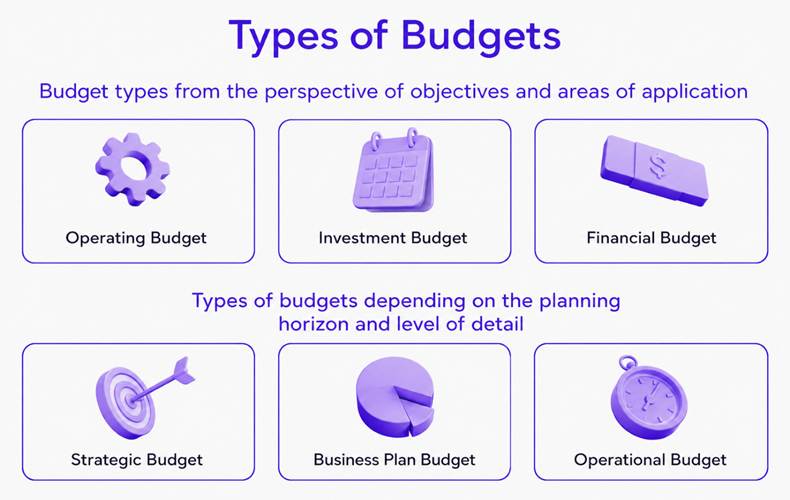
Depending on the planning horizon and level of detail, three types of budgets can be distinguished:
Strategic Plan. Everything is highly individual here. Some particularly large companies consider a strategic plan covering the next 30–50 years. This extraordinary timeframe exceeds the average lifespan of a company in Russia (which is between 6 and 9 years). For small businesses or startups, even a 2–3-year plan may be considered long-term. However, on average, companies regard plans with a horizon of approximately 3–5 to 10 years as long-term. On this horizon, it is appropriate to plan entry into new markets, development and launch of new products, production modernisation, and similar initiatives. In some sense, a strategic plan is always somewhat “detached from reality.” At the same time, if a company approaches it with serious consideration, it can become a genuine tool for significant growth. To make it effective, it is necessary to ensure its connection with the company’s business plan and operational plans.
Business Plan. This is a company’s medium-term plan, typically prepared for a period of 1–3 years. Virtually all companies use an annual plan as the foundation for operations, analysis, and decision-making. Numerous types of reports are generated based on annual plan performance—management and accounting reports, as well as specialized reports, for example, for investors in the case of a public company. Decisions regarding employee bonuses, changes in supplier relationships, software acquisitions, and many other matters are typically made based on the analysis of deviations from the annual plan.
Operational Plan. In essence, this is a flexible version of the business plan, broken down into periods—months, ten-day periods, weeks, or days—depending on the company’s activities and needs. Its flexibility lies in the fact that the operational plan “flows” from one period to another and from one analytical perspective to another. For example, if a company finishes the first month of the year below its revenue target, then in the operational plan for the following month it may:
a) take the shortfall into account and reduce targets for the next month and the remainder of the year;
b) shift the unrealized revenue into future periods and increase targets for all subsequent months;
c) record the actual result and leave future targets unchanged.
Everything depends on the planning methodology and the decisions made (for example, launching a promotional campaign to increase demand, incorporating reduced demand into forecasts, or taking other actions).
It is at this level that short-term budgeting is implemented, ensuring rapid adaptation of plans to actual conditions and changes in the business environment.
Want to learn more?
Discover the capabilities of the “Economics and Finance Management” product for budgeting and financial planning automation.
Stages of Budgeting in a Company ↑ Back to contents
Budgeting is one of the main management business processes in any company. Like any other business process, it consists of several stages.
The budgeting process in an enterprise is a vivid example of a cross-functional business process. It always involves many stakeholders and, as a rule, is iterative in nature.
Stage 1. Defining targets and major parameters. Regardless of whether a top-down or bottom-up approach is used to prepare the budget, the business planning process should begin with a clear understanding of the company’s objectives for the planning period (usually one year). A budgeting model is also impossible without considering global factors that affect the business and are beyond the company’s control. Examples include key tax rates (VAT, corporate income tax, social contribution rates, etc.), the central bank’s key interest rate (for forecasting loan rates), prices of the company’s end products (for example, oil prices for oil-producing companies), exchange rates (for exporters), and even weather forecasts for companies whose demand is directly influenced by climate conditions.
Stage 2. Modeling and data collection. This stage differs depending on whether a top-down or bottom-up approach is used. Under the top-down approach, individual targets are developed for each functional area, and these targets are balanced before being passed to business units for detailed planning. Under the bottom-up approach, the overall objective is immediately communicated to the lowest planning level, after which departments independently plan activities to achieve it, and their plans are then consolidated into a single budget. In both approaches, the process is iterative. In both cases, the foundation of the company’s overall budget is formed by the budgets of departments or Financial Responsibility Centers (FRCs).
Stage 3. Review and approval of plans. The approval chain can be relatively simple or extremely long and complex, depending on the scale of the company and the adopted methodology. In today’s world, where there is little time for lengthy processes and decisions must be made quickly yet on a sound basis, even long approval chains can be completed relatively fast thanks to automation.
“A modern budgeting system must be capable of implementing calculation models of any level of complexity, working with large volumes of data, supporting approval workflows and integration with other systems, and being flexibly configurable. A budgeting system should allow financial specialists to quickly modify calculation approaches on their own, without long waits for system enhancements and budget approvals related to them. In short—like Excel, but in an enterprise-grade system.”
— Andrey Klopotovsky, Founder and CEO of K-Plan, former Director of Economics at the FESCO Transport Group.
Difficulties in the Budgeting Process ↑ Back to contents
In practice, budgeting is rarely a completely linear and predictable process. Even with established procedures and automated systems, companies regularly face several common challenges.
Low quality of source data.
Errors in source information, differences in calculation methodologies, and inconsistencies in data across departments reduce the reliability of the budget and complicate decision-making.
Long-term approvals.
In large companies, the approval process can take weeks. During that time, some of the underlying assumptions may already change: exchange rates, demand, resource costs, and production plans may all be revised.
Conflicting interests between departments.
Different departments often pursue different objectives: some are interested in increasing expenditures to support business growth, while others focus on reducing costs and adhering to spending limits.
Excessive process complexity and workload.
When large numbers of Excel files and manual operations are used, the workload on finance teams increases and the risk of errors grows significantly.
Limited flexibility of the budgeting model.
A static annual budget adapts poorly to rapidly changing market conditions. As a result, many companies are gradually moving toward more flexible approaches, such as rolling forecasts, driver-based planning, and xP&A.
Example of the Budget Formation Process ↑ Back to contents
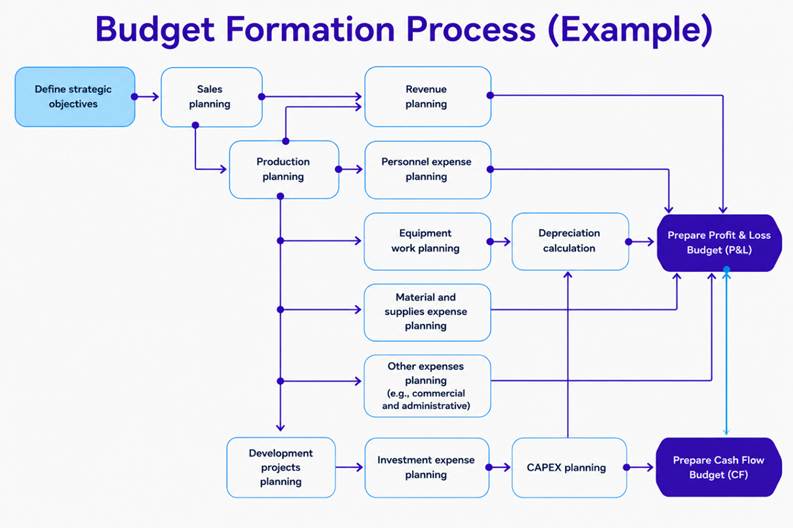
After the budget has been approved, the following processes are carried out:
- Monitoring the execution of plans by budget line items (both revenue and expense items);
- Identifying deviations from the plan (preferably in a proactive manner);
- Organizing the decision-making process aimed at achieving planned targets;
- Implementing decisions and monitoring their execution.
The Key to Effective Budgeting
Effective budgeting is not merely about controlling revenues and expenses; it is a business management tool that helps a company make timely decisions and adapt to change. The greatest value comes from planning models that are transparent, flexible, and closely connected to operational activities.
Modern Financial Planning Trend: The Transition to xP&A ↑ Back to contents
Leading analytical firms (for example, Gartner) emphasize the shift from traditional financial planning to xP&A (Extended Planning and Analysis).
The essence of xP&A is that finance is no longer planned in isolation. Financial plans are inextricably linked to operational plans. If the sales department changes its forecast, the financial budget should be recalculated instantly.
From this perspective, it becomes clear why budgeting and financial planning within a company are an integral part of the end-to-end Integrated Business Planning (IBP) process.
Conclusions and Key Thesis ↑ Back to contents
Effective digital budgeting is not about budget control, it is about managing company value, with sound financial resource planning at its core. The transition from static spreadsheets to integrated management systems enables the finance function to become a strategic business partner, making decisions based on well-developed and thoughtfully designed methodologies.
The same logic applies to project budget management. The management of project finances and project resource allocation must be synchronized with the company’s core business processes and integrated into the overall budgeting model.
Budgeting: Key Thesis
- Budgeting is a management process that helps a company plan revenue, expenses, cash flows, and the achievement of financial goals.
- An effective budgeting system not only enables cost control but also supports managerial decision-making, risk management, and investment evaluation.
- The foundation of financial planning in most companies consists of three key statements: Profit & Loss (PL), Cash Flow Statement (CF), and Balance Sheet (BS).
- Companies use different budgeting approaches, ranging from traditional incremental budgeting (“based on achieved results”) to driver-based models and flexible budgeting.
- The most important factors for effective budgeting are realistic plans, transparent calculations, stakeholder involvement, and model flexibility.
- The budgeting process typically includes goal setting, data collection and consolidation, plan review and approval, and subsequent budget execution monitoring.
- In practice, companies often face challenges such as long-term approval cycles, poor data quality, labor-intensive manual processes, and insufficient flexibility of budgeting models.
- As businesses grow, they gradually move from Excel and disconnected spreadsheets to specialized financial planning and budgeting management systems.
- A major trend in modern financial planning is the transition to xP&A (Extended Planning & Analysis), where financial and operational metrics are treated as a unified system of interconnected indicators.
Author: Zoya Taranchenko, Business Development Director at Knowledge Space and an expert in Integrated Business Planning.