Back
Back
 7 min?>
Table of Contents
- What Is S&OP?
- Stages of the S&OP Cycle
- Industry-Specific Characteristics of Planning Elements
- Components of S&OP
- Automation of S&OP Planning Elements
- The Evolution of S&OP into IBP: What’s New?
- Current Trends in the Development of Integrated Business Planning (IBP)
What Is S&OP? Back
Sales and Operations Planning (S&OP)
There are many definitions of Sales and Operations Planning. Some view S&OP as a management approach, while others consider it a management process. We believe that both perspectives are correct.
In our view, the following definitions are the most accurate and comprehensive.
S&OP is:
- a management approach designed to structure and align demand and supply in medium-sized and large organisations through a repeatable cross-functional process conducted on a monthly cycle;
- a repeatable cross-functional process that ensures continuous alignment of demand and supply within a company, both in the short term and the long term.
This process has always been objectively necessary. Without it, companies would struggle to meet market demand and fully utilize their production capabilities.
In one form or another, the S&OP process exists in every company—even if no one explicitly refers to it by that name. In smaller organisations, the process is typically less structured. As companies grow, it becomes necessary to formalize and automate the process in order to bring together employees who focus on different tasks and objectives on a daily basis.
A well-established S&OP process organizes the operations of a commercial enterprise so that it delivers the right products and services, with the required characteristics, at the right time, to the customers who need them.
Stages of the S&OP Cycle Back
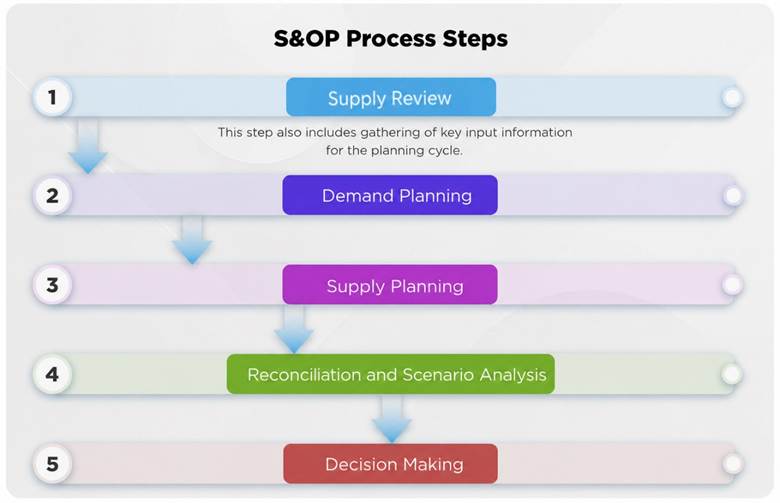
As an iterative process, typically conducted on a monthly basis, the classic S&OP cycle consists of five key stages.
1. Supply Review
At this stage, the company develops an understanding of what it will bring to the market by defining its product portfolio and assortment. While this step may seem unnecessary or non-obvious, it is critically important for many organisations. For example, if a product has become obsolete and demand is declining rapidly, it should eventually be removed from the company’s product portfolio.
2. Demand Planning
At this stage, various demand forecasting methods are applied, potential promotional activities and their impact on demand are evaluated, and a preliminary sales plan is developed by customer and distribution channel. This stage provides a clear understanding of the volume of products the market is likely to absorb.
3. Supply Planning
During the Supply Network Planning (SNP) stage, all available capabilities and constraints are assessed, including production capacity, logistics, inventory levels, and other operational factors.
At the same time, alternative solutions for meeting demand are developed. For example, if Product A is unavailable, customers may be willing to accept an alternative version with a small discount. Such an approach may prove more effective than incurring additional costs to produce Product A.
4. Reconciliation and Scenario Analysis
At this stage, the demand plan and supply plan are brought together and evaluated from a financial perspective using key business metrics. Different integrated planning scenarios are assessed, and key stakeholders align on the most suitable set of scenarios to be reviewed by senior management.
5. Decision Making at Executive Level
At the final stage, management selects the optimal planning scenario, which then becomes the approved plan communicated to the organisation for execution.
The S&OP process is cyclical. These stages are repeated at least on a monthly basis. Moreover, they may be repeated multiple times within a single planning cycle until the plan considered optimal by company leadership is identified and approved.
Industry-Specific Characteristics of Planning Elements Back
In our view, it is important to recognize that the S&OP process has significant variations across different industries. Depending on the nature of the business, the following components may play a dominant role within the process:
- Demand Planning is particularly relevant in industries characterized by a "buyer’s market," pronounced seasonality, or substantial demand sensitivity to external factors, especially where the supply chain can be relatively easily adjusted to changing demand patterns.
- Supply Planning is more critical for industries where demand is relatively stable and predictable, with only minor fluctuations, while the production and supply network is highly complex and difficult to reconfigure in response to changing volume requirements.
- Reconciliation, for example, for companies in the FMCG sector, the S&OP approach is essential because both demand and supply are equally important and require the most thorough balancing.
Components of S&OP Back
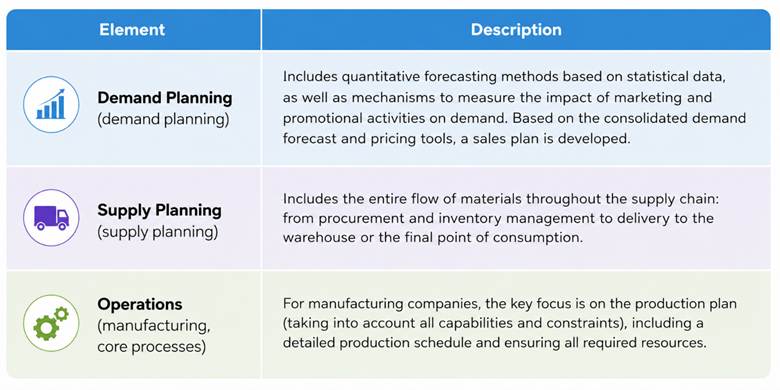
Sales and Operations Planning encompasses the key elements of an organisation's value chain. These elements are presented in the table below.
| Demand planning | Includes quantitative forecasting methods based on statistical data, as well as mechanisms for measuring the impact of marketing and promotional activities on demand. Based on the consolidated demand forecast and pricing tools, a sales plan is developed. |
| Supply planning | Includes the entire flow of materials throughout the supply chain, from procurement and inventory management to delivery to the warehouse or the final point of consumption. |
| Operations | For manufacturing companies, the production plan is a key element, taking into account all capabilities and constraints, including a detailed production schedule and the provision of all required resources. |
Automation of S&OP Planning Elements Back
The automation of these Sales and Operations Planning elements is typically supported by specialized software solutions:
- Demand Planning (DP) systems
- Supply Chain Planning (SNP/SCP) systems
- Production Planning and Detailed Scheduling (DPS) systems
These elements can be automated independently and may even be supported by different IT systems. However, in such cases, close integration between them is essential. In line with the core principles of S&OP, demand and supply plans are developed in a parallel and sequential manner and continuously balanced through an iterative planning and alignment process.
The Evolution of S&OP into IBP: What’s New? Back
Integrated Business Planning (IBP) can be viewed as a more advanced and broader approach compared to traditional Sales and Operations Planning (S&OP).
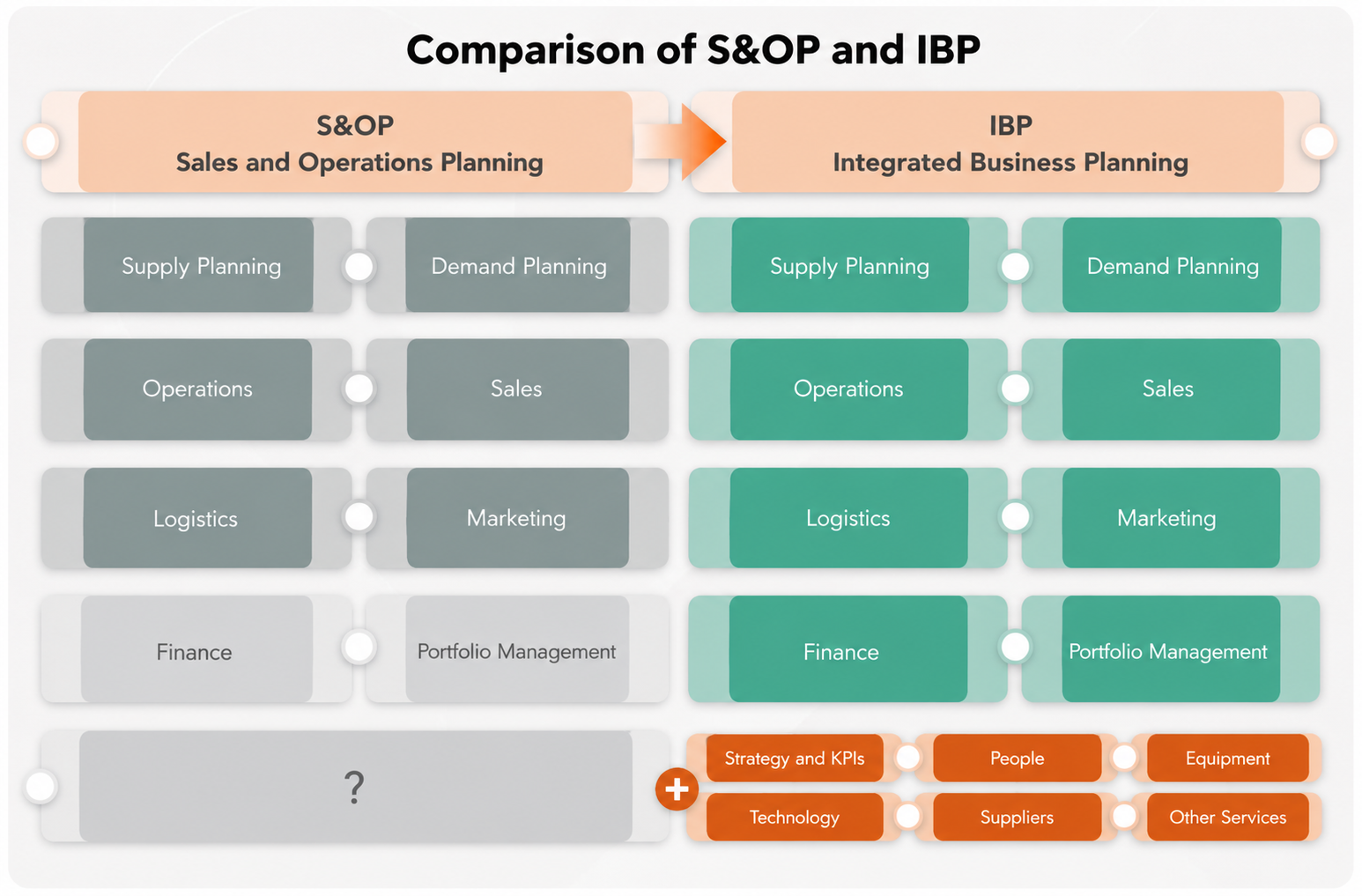
IBP expands the planning process by involving a greater number of functional areas and stakeholders. It incorporates the full scope of financial, economic, and investment planning, but its capabilities extend far beyond these areas.
While S&OP primarily focuses on the core business processes that form the foundation of an organisation's value chain, IBP encompasses an increasingly wide range of related functions and supporting processes.
Today, a comprehensive IBP framework typically includes the following planning domains:
- Demand Planning
- Marketing Planning
- Sales Planning
- Primary Production Planning
- Auxiliary Production Planning
- Workforce Planning
- Equipment Planning
- Equipment Maintenance and Repair Planning
- Technology Planning
- Procurement Planning
- Supply Planning
- Inventory Planning
- Logistics Planning
- Investment Planning
- Financial and Economic Planning
- Business Support Services Planning
- Planning of Activities with Related Business Partners and Contractors
- Strategy and KPI Planning
This list continues to expand over time.
Overall, IBP can be described as an approach aimed at integrating all company plans within a single information environment. Importantly, this integration is not limited to the technical level; it is primarily achieved at the methodological level.
In other words, any new input, assumption, or business event can influence the overall integrated plan to varying degrees, depending on the defined and quantified cause-and-effect relationships within the planning model.
Current Trends in the Development of Integrated Business Planning (IBP) Back
The evolution of IBP suggests that, ultimately, no area of activity—either within the company itself or among its key business partners—should remain outside the scope of the integrated planning framework.
In its modern interpretation, Integrated Business Planning encompasses not only operational and financial plans but also the company’s strategic plan, including its goals hierarchy, KPI framework, and strategic business model. It further incorporates plans for all critical resources, such as equipment, technology, and workforce, as well as the plans and activities of key contractors and external service providers.
In our view, there are two major trends shaping the future development of IBP as a management approach:
- End-to-End Digitalisation. This trend is driven by the fact that integrated planning involves a large number of stakeholders and an enormous volume of data. Without digital technologies and advanced planning systems, the execution of the IBP process becomes virtually impossible.
- Enterprise-Wide Collaboration. The greatest opportunities for efficiency improvement within IBP are found at the intersections between business functions. Therefore, successful IBP requires continuous, high-quality collaboration among all participants—both within the organisation and across its external ecosystem of partners and suppliers.
As a result, modern IBP is increasingly becoming a comprehensive enterprise management framework that connects strategy, operations, finance, resources, and partner networks within a single integrated planning environment.
Related Article:
What Is Integrated Business Planning and What Business Benefits Can It Deliver?
Author:
Zoya Taranchenko, Business Development Director at Knowledge Space and an expert in Integrated Business Planning.